 Skip to content


How To Calculate your dilution Ratio
Dilution Ratios: a manufacturer’s guide to getting the best out of your product. They can seem daunting, but the math is simple

How to Dilute Concentrate Products
The three most common are dilution ratios, percentages, and 1L examples (for instance, 200ml of product mixed with 800ml of water). In this post, we’re following on from our video ‘Dilution Ratios – What Are They?’, and taking a closer look at how to work out a ratio correctly.
If you’ve ever looked at a ratio and felt completely confused, you’re definitely not alone! Information on this topic can be hard to find — and when you do find it, it’s often wrong. There are lots of online calculators that promise an easy way to figure out your measurements, but unfortunately, many of them aren’t accurate.
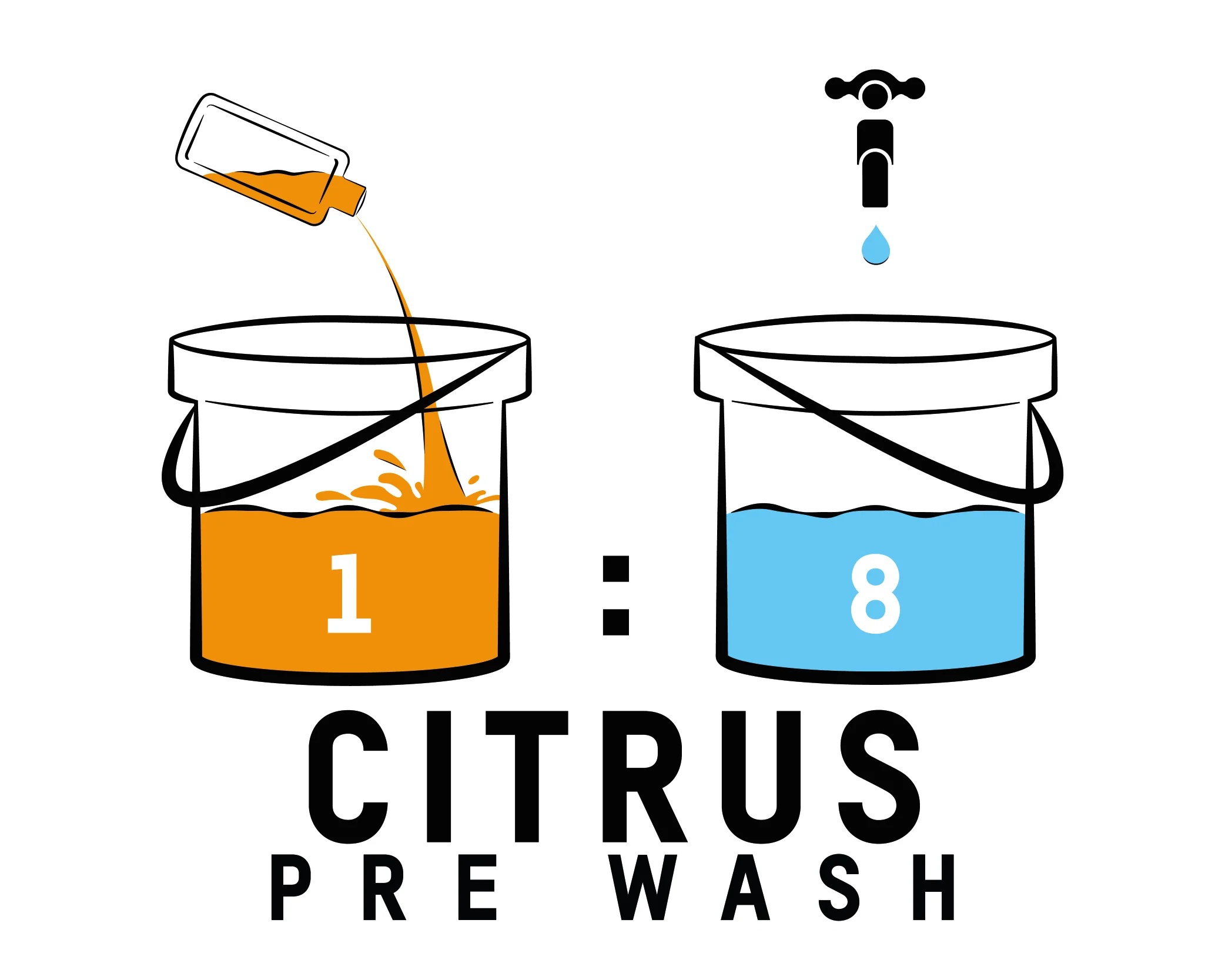
So, to clear things up, we’ll be using our Citrus Pre Wash as an example, which has a dilution ratio of 1:8.
But first — what exactly is a ratio? In simple terms, it’s just an instruction that tells you how much product to mix with how much water, no matter the size of your container. A ratio like 1:8 simply means 1 part product to 8 parts water. The part size is determined by the container size. Citrus PRE Wash often gets used in a 1.5Ltr pump Sprayer. In our 1:8 ratio there are a total of 9 parts. Divide the number of parts by the total liquid volume. 1500ml divided by 9 parts = 166ml per part. 166ml of Citrus PRE Wash and then 8 x 166ml =1,334 ml of Water. You don’t really need to be accurate to the ml as you can use this product at a stronger dilution. Think of this as a guide. 1:8 with Citrus PRE Wash is our Max dilution.
The Calculation
Now that we understand what a ratio means, let’s work out how to actually calculate it.
As a general rule, start by adding the numbers in your ratio together.
So, for our example of 1:8, we do this:
1 + 8 = 9
Next, you’ll need to know the size of the container you’re diluting the product into. Most foam lance bottles and trigger spray bottles hold around 1 litre (1000ml), so we’ll use that for our example.
First, convert the volume into millilitres:
1L = 1000ml
Now take that container size (1000ml) and divide it by the total of your ratio numbers (1 + 8 = 9):
1000 ÷ 9 = 111ml
That means 111ml is your product amount — this represents the 1 part in your ratio.
Next, subtract that amount from your total container size to find out how much water you’ll need:
1000ml – 111ml = 889ml
So, in this example, you’ll need 111ml of product and 889ml of water.
Mix the two together and voilà — your perfect dilution is ready to go!
A Few Other Examples
Let’s look at a few more examples so you can see how this works in different situations.
Classic All Purpose Cleaner – Dilute 1:10
Trigger Bottle: 1L (1000ml)
1 + 10 = 11
1000ml ÷ 11 = 90.9ml (round up to 91ml for simplicity – this is your product measurement)
1000ml – 91ml = 909ml (your water measurement)
✅ Answer: 91ml of product to 909ml of water
Advanced Interior Cleaner – Dilute 1:20
Trigger Bottle: 1.5L (1500ml)
1 + 20 = 21
1500ml ÷ 21 = 71.4ml (round down to 71ml for simplicity – this is your product measurement)
1500ml – 71ml = 1429ml (your water measurement)
✅ Answer: 71ml of product to 1429ml of water
Enzyme Odour Eater – Dilute 1:5
Trigger Bottle: 950ml
1 + 5 = 6
950ml ÷ 6 = 158ml (rounded down – this is your product measurement)
950ml – 158ml = 792ml (your water measurement)
✅ Answer: 158ml of product to 792ml of water
A Quick Note About Dilution Strength
More product isn’t always better! Take Snow Seal, for example — one of our spray-on sealants that contains silicone. With this product, less really is more. Over-applying can lead to silicone spotting, which just means more work for you later.
Now, Snow Seal won’t damage your paintwork — any excess can usually be wiped away with a quick detailer, like our Classic Quick Detailer. But there are stronger products that aren’t pH neutral — such as our Alkaline Bilberry Wheel Cleaner. It’s fantastic on lacquered wheels, but if your wheels are unlacquered, under-diluting Bilberry could cause problems.
As a general rule:
- If a product contains silicone or isn’t pH neutral, stick closely to the manufacturer’s dilution guidelines.
- For pH neutral products, you can often get away with a slightly stronger mix — within reason — and sometimes it can even work to your advantage.
So… Should I Stick to the Manufacturer’s Dilution Ratio?
In most cases, yes — as close as you can. Our recommended ratios are based on performance and value for money. We don’t expect you to measure it to the exact millilitre, but keeping roughly within the suggested range is ideal.
There’s a bit of flexibility, but make sure you understand what you’re working with before you start diluting. That way, you’ll get the best results and the most from the products you’ve invested in.
Watch the Video
Haven’t seen our Introduction to Dilution Ratios video yet? Click here to watch it!
About ValetPRO
At ValetPRO, we fuel your car care passion and help you achieve a flawless finish you can be proud of. We’re trusted by trade professionals, retailers, detailers, and car enthusiasts around the world.
🌐 Discover more: www.valetpro.global
💌 Don’t forget to subscribe to get access to:
- Exclusive offers
- Blogs & guides
- ValetPRO news
Subscribe today and stay connected!